
Cos I white
CHAPTER ONE: THE GREYHOUND'S GHOST
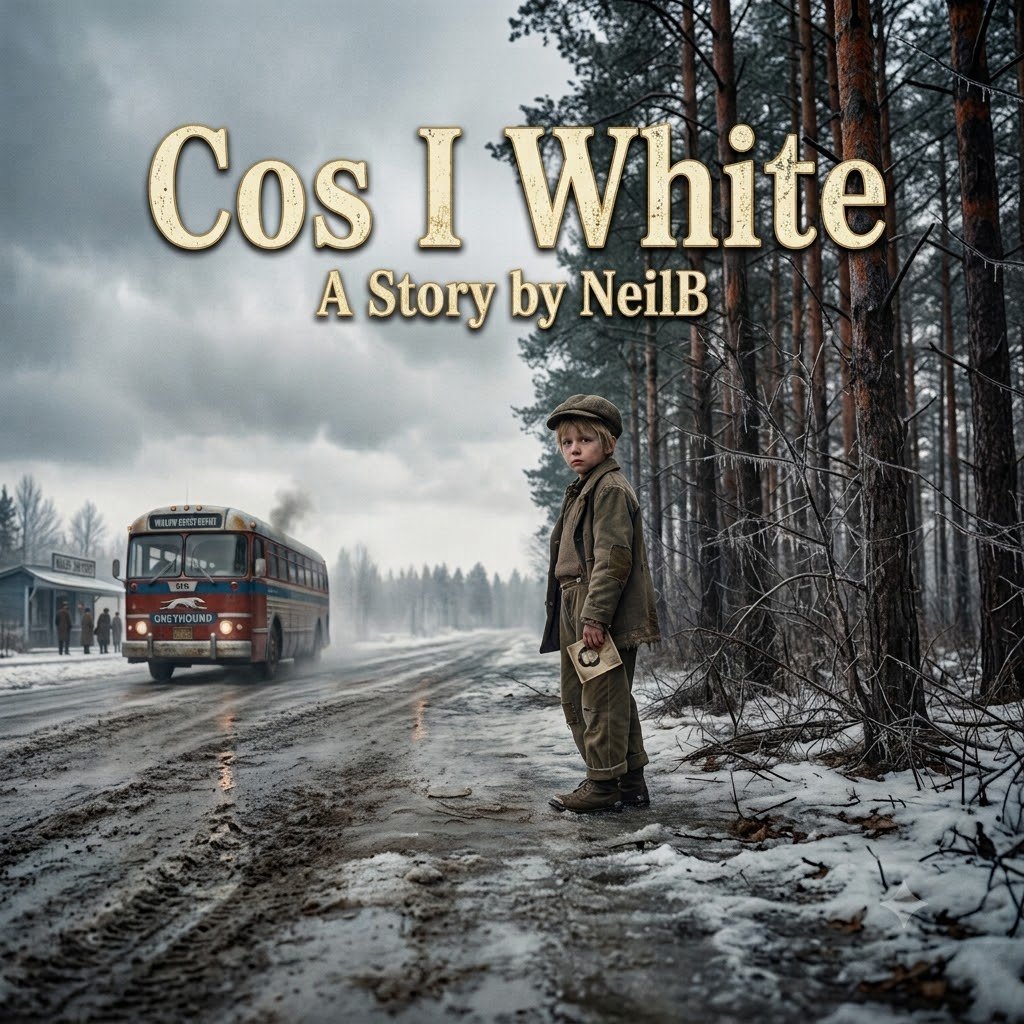
The Greyhound bus coughed and sputtered as it lurched to a halt at the edge of Willow Creek, Mississippi, its ancient engine rattling like a dying man's last breath. The winter of 1952 had descended upon the South with a vengeance, turning the red clay roads into frozen ruts and coating the bare branches of the pine trees with a thin, glittering layer of ice. The sky was the color of old pewter, heavy and low, threatening snow that never quite came, only a bitter, bone-deep cold that seemed to seep through the walls of every building and the layers of every coat.
Inside the bus, the air was thick with the smells of diesel, sweat, and the faint, sour odor of too many bodies crowded into too small a space. The passengers were a motley collection of humanity — black sharecroppers heading south to visit relatives they hadn't seen in years, a white traveling salesman with a cheap suitcase full of fabric samples and a mouth full of cheap jokes, an elderly woman clutching a worn Bible to her chest, and a young mother with haunted eyes and a small boy clinging to her hand like she was the only anchor in a storm-tossed sea.
The mother was thin, painfully so, her cheekbones sharp beneath skin that had the pallor of someone who hadn't seen proper sunlight or proper food in far too long. Her coat was a thin, threadbare thing, patched in several places, wholly inadequate for the bitter cold that had settled over the region. Her hands, when she wasn't clutching her son's, trembled constantly — whether from the cold or from something else, the boy couldn't tell. She wore no wedding ring, and her eyes, when they weren't scanning the windows for some unseen threat, were filled with a deep, abiding sadness that seemed to have taken up permanent residence behind her gaze.
The boy was perhaps seven years old, though he was small for his age, stunted by years of hunger and the kind of neglect that comes not from malice but from sheer, grinding poverty. His hair was the color of pale straw, matted and unkempt beneath a woolen cap that had been knitted by a grandmother he barely remembered. His clothes were clean but worn, patched and mended so many times that the original fabric was almost invisible beneath the layers of thread. His shoes, thin-soled and cracked, had holes in the toes that his mother had tried to stuff with newspaper.
But it was his eyes that made people pause. They were the color of a winter sky just before dawn, a pale, piercing blue that seemed far too old for such a young face. Those eyes had seen things no child should ever see — hunger, violence, the casual cruelty of a world that had no use for people like him and his mother. They had seen motel rooms and bus stations and the back seats of cars that served as temporary homes. They had seen the backs of too many people who had turned away, unwilling or unable to help.
And now, as the bus shuddered to a stop at the Willow Creek depot, those eyes were fixed on his mother's face, watching her every expression, trying to read the fear that flickered behind her eyes like a candle in a high wind.
"Mama?" he whispered, his voice hoarse from disuse and the dry, recirculated air of the bus. "Where are we?"
His mother didn't answer at first. She was staring out the window, her gaze fixed on the small, sleepy town that had materialized out of the gray landscape. Willow Creek was barely a dot on any map, a forgotten crossroads where the main street consisted of a handful of buildings — a grocery store with a faded sign, a diner with a flickering neon sign that promised "Good Eats," a barber shop with a red-and-white pole that hadn't been painted in years, and a church with a white clapboard steeple that rose above the treetops like a silent prayer.
It was the kind of town that time seemed to have passed by, a place where the past lingered in the air like the smell of woodsmoke from a dying fire. The streets were empty at this early hour, the shops still closed, the only signs of life a few chickens scratching in a dusty yard and a mongrel dog sleeping on the steps of the general store.
"We're here," his mother said finally, her voice barely above a whisper. "This is where we get off."
The boy felt a cold knot form in his stomach. He had learned to recognize the signs — the way his mother's voice tightened, the way her hands trembled, the way she avoided his eyes when she was about to do something she knew would hurt him. They had been running for as long as he could remember, moving from town to town, motel to motel, always one step ahead of something he didn't understand. And every time they stopped, it was only to catch their breath before the running began again.
"Mama, I'm scared," he said, his voice small and fragile.
She turned to him then, and for a moment, the mask slipped. Her eyes filled with tears, and she pulled him into a fierce embrace, her thin arms wrapped around him so tightly that he could barely breathe. Her body was shaking, trembling with a grief so profound that it seemed to have no bottom.
"I know, baby," she whispered into his hair. "I know you're scared. But you have to be brave for me, okay? You have to be the bravest little boy in the whole world. Can you do that for me? Can you be brave?"
He nodded against her chest, his own tears soaking through her thin coat. "I'll be brave, Mama. I promise."
She pulled back, cupping his face in her hands, her eyes searching his with a desperate intensity. "I need you to remember something, William. I need you to remember that I love you. More than anything in this world. More than my own life. You understand that, don't you?"
"Yes, Mama."
"And I need you to remember that no matter what happens, no matter where you are, I will always be with you. In here." She pressed her hand to his chest, over his heart. "You carry me with you, always. Okay?"
He nodded, not understanding why she was saying these things, why she sounded like she was saying goodbye.
The bus driver, a heavyset man with a thick mustache and a perpetual scowl, bellowed from the front of the bus. "End of the line! Everybody out! This ain't a hotel!"
The other passengers shuffled toward the exit, gathering their belongings, stepping out into the cold morning air. The boy watched them go, feeling a sense of dread that he couldn't quite articulate. His mother was still holding him, still trembling, still crying silent tears that streaked down her face like rain on a window.
"Come on, baby," she said finally, standing up and pulling him to his feet. "It's time to go."
She led him off the bus, her steps unsteady on the icy platform. The driver, eager to be rid of them, had already tossed their single, battered suitcase onto the ground. It burst open on impact, spilling a few threadbare dresses and a pair of small trousers onto the frozen mud. His mother didn't stop to pick them up. She pulled him away from the depot, her eyes scanning the town with a wild, desperate intensity.
"Where are we going, Mama?" he asked, his legs struggling to keep up with her frantic pace.
"Just a little further," she said. "Just a little further, baby."
They walked through the town, past the grocery store where a woman was unlocking the front door, past the diner where the smell of frying bacon and coffee drifted out into the cold air. A few people were out and about — mostly black men and women heading to work as domestics or laborers in the white neighborhoods. They looked at the pale, thin woman and the small, frightened boy with curiosity, then quickly looked away. In the South, a white woman in such obvious distress was a complication, a problem that no one wanted to touch.
They reached the edge of town, where the paved road gave way to a dirt track that wound into the dense pine forest. The trees loomed dark and forbidding, their branches reaching out like skeletal fingers. The boy felt a chill that had nothing to do with the cold.
"Mama, I don't like this," he said. "Can we go back?"
No reviews found!









No comments found for this product. Be the first to comment!